

Page 11 / May 07
DYSKERATOSIS CONGENITA
 Next page /
DISCUSSION
DYSKERATOSIS CONGENITA
- A rare inherited condition characterized by cutaneous reticulated hyperpigmentation, nail dystrophy, premalignant leukoplakia of the oral mucosa, and progressive pancytopenia.
- The mutant gene is DKC1 (located at Xq28) in the families studied.
- The inheritance pattern of most cases of DKC is X-linked recessive, but autosomal dominant and recessive patterns have been reported.
- Autosomal dominant form usually lack the classical skin findings. It is also associated with idiopathic pulmonary fibrosis.
- Mutations in telomerase enzymes (hTERT and hRT)- MY Armanios et al., NEJM 2007; 356:1317-1326.
- Clinical:
- The mucocutaneous features of DKC typically develop between age 5 and 15 years.
- learning difficulties or mild-to-moderate mental retardation in 21%.
- Short stature in 16%.
- Underdeveloped or undescended testes in 8%.
- Abnormal bone trabeculation or osteoporosis in 4%.
- Cutaneous findings:
- Abnormal skin pigmentation with tan-to-gray hyperpigmented or hypopigmented macules and patches.
- Typical distribution is on the upper trunk, neck, and face (involvement of sun-exposed areas).
- Clinically and histologically resemble graft versus host disease.
- Other findings: scalp alopecia that can also involve the eyebrows and eyelashes, hyperhidrosis, hyperkeratosis of the palms and soles, and adermatoglyphia (loss of dermal ridges on fingers and toes).
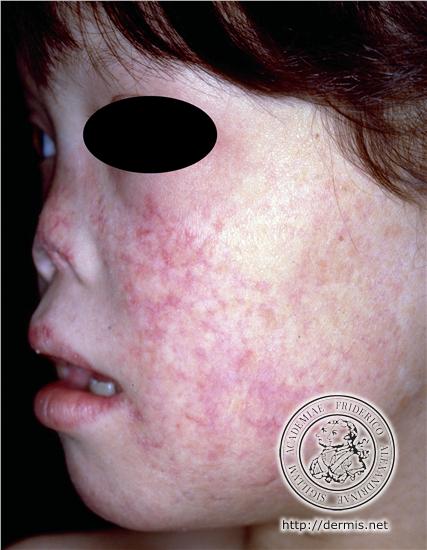
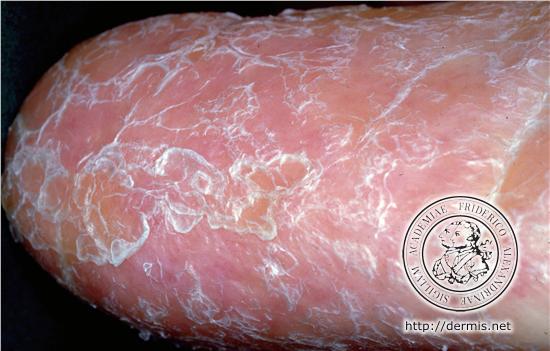
DKC1 DKC2 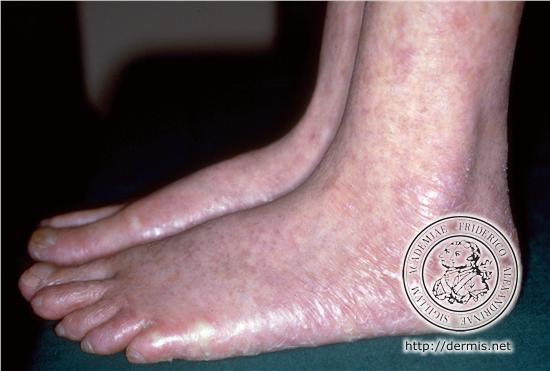
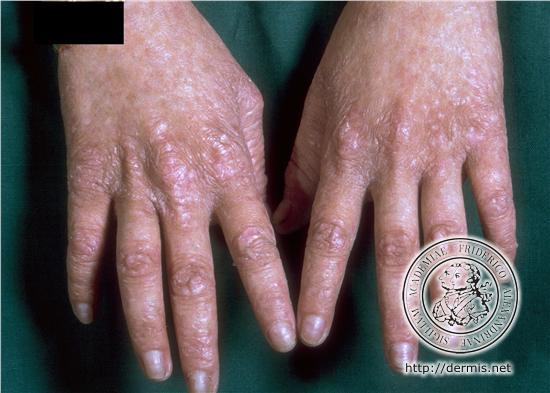
DKC3 DKC4
- Mucosal findings:
Mucosal leukoplakia typically occurs on the buccal mucosa and can affect the tongue and oropharynx. The leukoplakia may become verrucous, and ulceration may occur.
Other mucosal sites may be involved (eg, esophagus, urethral meatus, glans penis, lacrimal duct, conjunctiva, vagina, anus). Constriction and stenosis can occur
May not develop until the second or third decade and, on occasion, not until after the onset of bone marrow symptoms.
Increased incidence of malignant neoplasms, squamous cell carcinoma of the skin, mouth, nasopharynx, esophagus, rectum, vagina, and cervix.
Increased incidence and severity of dental caries and tooth loss 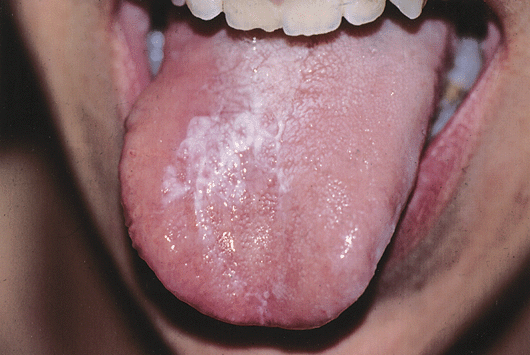
- Nail findings:
Progressive nail dystrophy begins with ridging and longitudinal fissures, with progressive atrophy, rudimentary, or absent nails 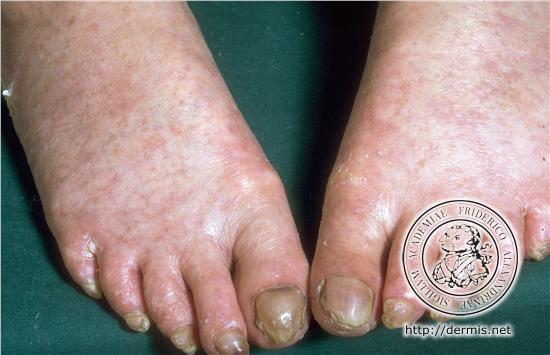

- Bone marrow failure:
Approximately 90% had peripheral cytopenia of one or more lineage, with a median age of onset of 10 years. - Pulmonary complications:
Recent review of data from the Dyskeratosis Congenita Registry indicates pulmonary disease in 20.3% of 148 patients from 92 families.
Affected patients had reduced DLCO and/or a restrictive defect on pulmonary function testing.
Pulmonary complications are the second most common cause of death in patients with DC, about half occurring in patients who undergo BMT. - Verra et al, Eur Respir J.1992;5:497-499: Reported 39 y male with DC diagnosed15y ealier who did not undergo BMT. Autopsy result showed nonspecific collagenous interstitial fibrosis.
- Yabe et al, Bone Marrow Transplant.1997;19:389-392: Reported a 9 y old boy who was dignosed at age 2. Autopsy result showed mixed inflammatory cell infiltrate of bronchioles and alveoli with interstitial fibrosis
- Kilic et al, Pediatr Int.2003;45:740-742: Reported a 10 y old boy who was diagnosed at the age of 1. Autopsy result showed abnormal level of fibrosis and dense,thick reticular fibers in stroma.
- Imokawa et al, Intern Med.1994;33:226-230: Reported a 46 y old male who was diagnosed at the age of 15. Surgical biopsy showed UIP.
- Safa et al, Thorax.2001;56:891-894: Reported 40 y old male who was diagnosed at 10 y of age. Surgical biopsy showed UIP. Patient died 38 mo after biopsy. No corticosteroids received and no BMT.
- Utz et al, Mayo Clin Proc June 2005;80(6):817-821: Reported 2 male patients aged 28 and 48 who were both diagnosed at 10 y of age. Surgical biopsies on both showed UIP. The first patient had BMT 12 y prior to biopsy and died 4 mo post. 2nd patient did not undergo BMT or corticosteroids and died 6 mo after biopsy.
- Usual Interstitial Pneumonitis:
Pathologic pattern for patients with a clinical diagnosis of idiopathic pulmonary fibrosis (IPF) or cryptogenic fibrosing alveolitis (CFA).
Architectural destruction, fibrosis often with honeycombing, scattered fibroblastic foci, patchy distribution, and involvement of the periphery of the acinus or lobule.
The prognosis of adults with UIP is poor.
Majority of patients succumbing within 5 years of diagnosis.
Children given a diagnosis of IPF or CFA often live much longer and have a nonprogressive course, suggesting that they do not have UIP.
Next page /