

ANSWER
Our diagnosis at this point was that of an abscess within an underlying pulmonary sequestration.We proceeded with a chest tube insertion, which was pushed into the abscess cavity. Very thick greenish fluid drained initially, but the culture and gram stain were negative. Epithelial cells were found in the fluid, but few neutrophils. The chest tube remained in place for 4 days, draining a further 180 milliliters overall. She was much improved clinically then. A bronchoscopy was done simultaneously to look for any obstructions or bronchial abnormalities, but was negative.
THE FOLLOW-UP CHEST RADIOGRAPH AT THAT TIME IS SHOWN BELOW.

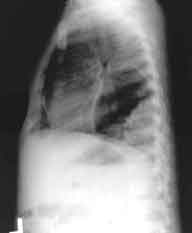
ENLARGE the chest X-ray top LEFT, RIGHT
She was transferred back to the regional hospital to complete one more week of antibiotic therapy intravenously with the intention to shift her to oral antibiotics for at least 3 more weeks. Reevaluation clinically and radiographically are anticipated at that time. A surgical resection of the sequestration is planned for in about 6 months time, in order to let the inflammation settle.
SEQUESTRATION
Definition: modified Bryce definitiondisconnected or abnormally communicating broncho-pulmonary mass or cyst with normal or anomalous arterial supply or venous drainage. Taussig 98 text book.
Prevalence : 0.15-1.7% of all congenital pulmonary malformations. Salmon et al 2000
TYPES
Intra pulmonary– 90%
– Mid childhood
– No communication to the normal proximal airway
– Posterior basal segments of the LLL
– Systemic blood supply: a single large vessel, pulmonary veins
– May be cystic
Extra pulmonary
– 10%
– Younger age
– Occasionally communicate with the intrapulmonary structure
– Costodiaphragmatic sinus/below diaphragm diaphragmatic hernia, Tracheoesophageal fistula
– Systemic blood supply: numerous, small vessels systemic/ portal
– Likely to be solid
REVIEW STUDIES
Louie et al (the American surgeon 93)– 10 cases/75-92
– Sex: 7 females, 3 males
– Age:7 children median age of Dx 29days, 3 adult with median age of Dx 32 years
– Symptoms: recurrent pneumonia, respiratory distress
– CXR consistent with diagnosis in 7
– CT in 6 pts suggests sequestration in all but one
All patients had Lobectomy with no complications.
Results: 5 intralobar, 5 extralobar, vessels originating from descending aorta in 8
Conclusions: CT chest most informative to reach diagnosis, but definitive diagnosis is made at thoracotomy, the resection yielding excellent results.
Michael
Curtis et al (J US med 97)
Reported an infant with history of abdominal mass diagnosed in utero
using ultrasound.
Neuroblastoma was diagnosed at 11 days of age, the laparatomy showing
a fleshy mass, and the pathologic examination consistent with sequestration
and CCAM.
Literature:18 sequestrations and 46 neuroblatoma
Conclusion:
sequestrations : echogenic, left sided, diagnosed in the 2nd.trimester
neuroblastoma: cystic, right sided, identified in 3rd.trimester
Sequestrations appear to be more common.
Rubin
et al (chest 94)
Reported a of case of a 29 year old women who died of massive hemoptysis
due to hemorrhage into the tracheobronchial tree from intralobar sequestration.
The diagnosis had been made in the childhood. This emphasizes the need
of early surgical treatment of pulmonary sequestration.
Watine
et al (eur j cardiothoracic sur 94)
Reported successful treatment of pulmonary sequestration with video-
assisted thoracoscopic resection in a 12 year old girl with history
of repeated episode of bronchitis and abnormal chest x-ray.
Carcia
ÐPena et al (ped radiol 98)
Reported spontaneous involution of pulmonary sequestration in two children.
1. asymptomatic 2-day-old boy with large echogenic mass in the left-sided
supradiaphragmatic region with large feeding vessels confirmed by Doppler
ultrasound. The mass disappeared by ultrasound 6 years later.
2. 3 month old boy with a soft tissue density mass in the LLL with large
feeding vessels Diagnosis with enhanced CT. 5years later significant
shrinkage of the mass with CT chest.
Their conclusion was that a conservative approach to asymptomatic
sequestration is indicated.
M.R.
Aulicino et al (Arch path lab med 94)
Reported
a neonate asymptomatic with retroperitoneal mass consistent with neuroblastoma.
The eventual peri-operative diagnosis was that of an intralobar sequestration
with feeding artery from abdominal aorta. The histopathology was consistent
with CCAM type 2.
Literature: 13 cases of CCAM & extrapulmonary sequestration.
COMPLICATIONS
– Recurrent chest infection– Congestive heart failure
– Lobar emphysema
– Hemoptysis
– Hemothorax
– Pleural effusion
– Pleuritis
 NEXT PAGE